Glaucophane Spectrum

|
|
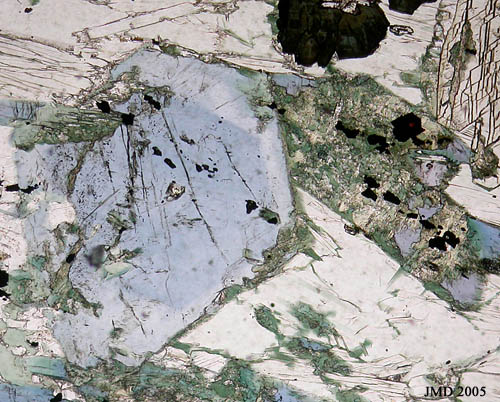
In this page and next one, I have recorded a few spectra on
a blue schist thin section containing pleochroic glaucophane crystal.
Those crystals have a very low 2V optic axes angle and a negative optic
sign. The pleochroism is violet (g),
blue (b) and colorless (a).
This glaucophane is in fact the crossite variety.
This section in the prism has an index between a and b. It has a pale blue color. |
|
|
Same section with polarizer rotated by 90°. Index close to g with a strong violet color. |

|
|
The spectra of the crystal above is shown here. The large band moving from 18100 cm-1 to 16000 cm-1 is responsible for the color violet to pale blue when the polarizer is rotated. The large bands come from the charge transfer between Fe++ and Fe+++ ions. The small band at approximately 22800 cm-1 arises from crystal field transition in Fe+++ ions. |

 |
Another crossite section nearly parallel to the crystal prism with a pleochroism violet to nearly colorless. This section is oriented with index close to g in horizontal position. |
 |
Polarizer is rotated by 90° with its principal direction now vertically oriented. The crystal has still a very pale violet color. |
 |
Spectra of the prismatic section above. |
[Home] [Main Page] [Next page]